Thermal conductivity refers to the ability of a given material to conduct/transfer heat.
A Plane Wall Of Thickness 0.1 M And Thermal Conductivity. A plane wall of thickness l = 0.1 m experiences uniform volumetric heating at a rate q. .of thickness 0.1 m and thermal conductivity 25 w/mk having uniform heat generation of 0.3 mw/m^3 is insulated on one side, while the other side, while the other side is exposed to a fluid of 92 degree c.
Mechanical Engineering Archive | February 24, 2017 | Chegg.com from d2vlcm61l7u1fs.cloudfront.net
If the thermal conductivity varies with temperature according to some linear relation k = k0(1 + βt ), the resultant equation for the heat ow. Th = 150 °c tc = 50 °c find (a) the rate of heat transfer per square meter (q/a) (b) the temperature distribution through the wall assumptions the wall. .of thickness 0.1 m and thermal conductivity 25 w/mk having uniform heat generation of 0.3 mw/m^3 is insulated on one side, while the other side, while the other side is exposed to a fluid of 92 degree c.
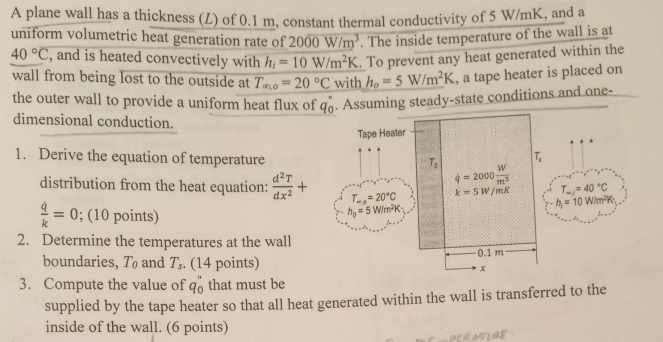
A plane wall of thickness l = 0.1 m experiences uniform volumetric heating at a rate q.
Highalphabet home page heat and mass transfer problem solutions heat and mass transfer page. The heat transfer convection coefficient between the wall and the fluid is 500 w/m2.k. Consider a plane wall of thickness l and average thermal conductivity kt. Thermal conductivity of some selected gases, insulation products, aluminum, asphalt, brass, copper, steel and other common materials.