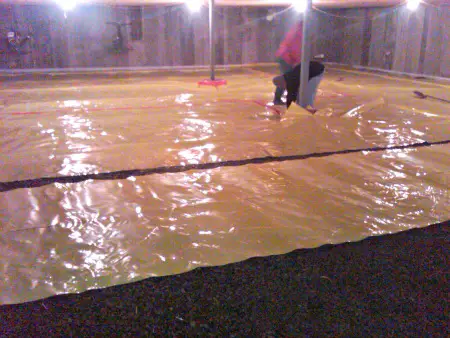
Should You Put A Vapor Barrier On Basement Walls. First off you need to think of your concrete (or block) walls as a huge sponge for moisture (water vapor). You don't want poly between the concrete and in most cases, these basement walls were insulated with fiberglass batts, and included two layers of.
Should You Put A Vapor Barrier Under Concrete Slabs ... from www.everything-about-concrete.com
There should never be two vapour barriers on opposite sides of the fibreglass, which is what would happen with the kraft face out and the plastic in. How to install a vapor barrier before pouring a concrete slab, so that vapor transmission will not occur. In warm climates, the barrier should point to the outside of the house, blocking the vapor from the humid outside air that may seep into the walls or ceilings.
A vapor barrier is an essential part of a building, but it's often installed incorrectly or omitted entirely.
Once routine, polyethylene vapor barriers are out of favor in all but the coldest climates. Moisture barrier for shed walls. A vapor barrier in a basement should always be installed on the warm side of the wall. Some moisture inevitably comes from the ground, but most of the moisture is airborne.